
Inside Iran's State-Sponsored Media Tours for Foreign Journalists
While the internet was severely restricted for Iranians, the foreign guests of the Sobh Media Festival were granted unlimited access to broadcast unedited state propaganda.

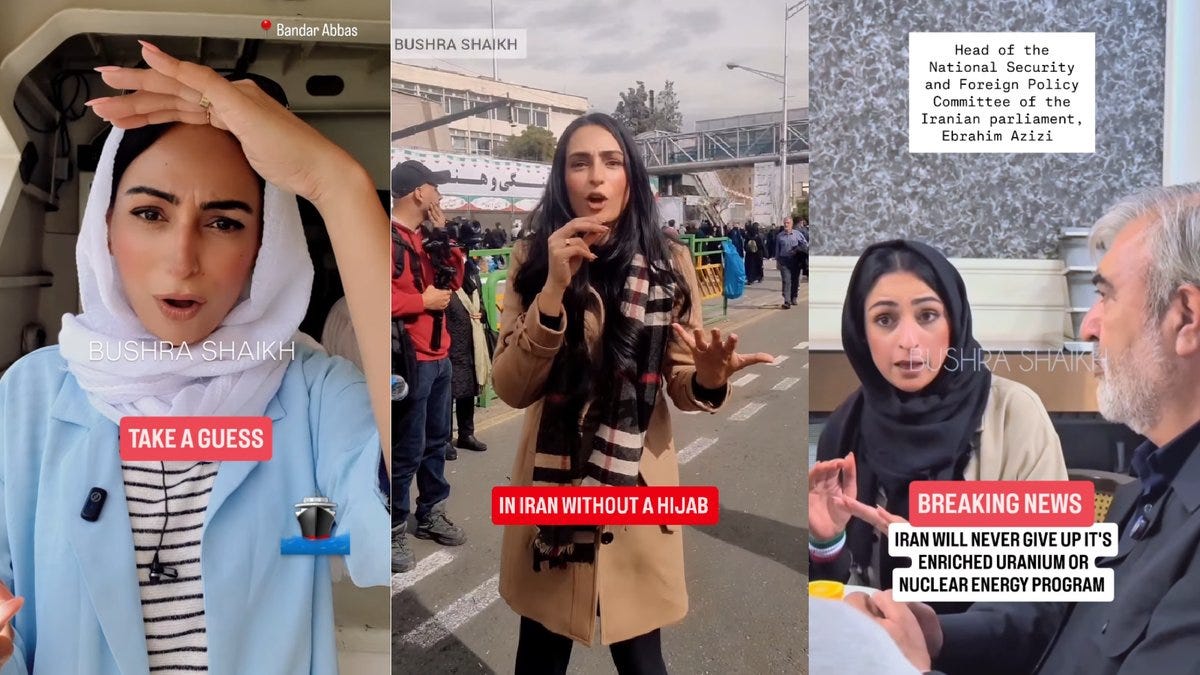
With the explosive growth of social media, traditional news outlets have lost their monopoly on reporting global events. Today, many audiences in the West and beyond skip massive news networks and trained journalists entirely, turning instead to the unfiltered feeds of digital “influencers”.
The Islamic Republic of Iran has keenly recognized this shift. Over the past year, as the country faced nationwide uprisings and regional wars, the state abandoned traditional media engagement in favour of a sophisticated new strategy to control the narrative. Instead of elite war correspondents, Iran is bringing foreign influencers, small news page administrators, and social media activists directly into the country.
One of the pillars of this new global influence operation is the Islamic Republic of Iran Broadcasting (IRIB) World Service.
The Mastermind: IRIB World Service
The IRIB World Service is the international division of Iran’s state broadcaster. It is responsible for creating the groundwork and facilities for this new era of digital narrative laundering. Broadcasting in over 30 languages, including English (PressTV) and Spanish (HispanTV), the World Service’s overarching mission is to bypass traditional Western journalism. By beaming its desired political narratives directly to global audiences through the guise of relatable, independent voices, Iran aims to counter Western narratives and increase its geopolitical influence.
To execute this strategy, an IRIB-run initiative called the Sobh Media Festival (inaugurated in 2023) organized highly coordinated media tours for these foreign “journalists, filmmakers, and media activists”. This represents a highly adaptable public relations pivot, aimed at projecting a manufactured image of strength and unity to the West while silencing dissent at home.
The Media Tours: Whitelisted Access During a Blackout
The Sobh Media Festival organized its first tour right after the violent suppression of the January nationwide protests, attempting to recast the state’s response for a global audience. Less than three months later, during the 40-day war in March and April 2026, a second and third tour was launched.
The second media tour was launched on March 20, 2026, right in the middle of the ongoing war. This iteration featured four participants: Dimitri Lascaris, a Canadian journalist and lawyer; Tim Anderson, an Australian author; Adem Metan, a Turkish journalist and radio host; and Ahmed, co-founder of the media outlet Propaganda & co. Throughout their stay, they published on-the-ground field reports covering the active conflict within Iran.
A third tour was subsequently organized a month later, commencing on Tuesday, April 21. From the very moment of their arrival, the participants began broadcasting a steady stream of photos and videos to their audiences
The conditions of these tours expose the reality of Iran’s strategy. The tour was held while the internet in Iran was almost entirely shut down for regular citizens. Despite this severe digital blackout, the foreign influencers on the tour were granted unlimited, “whitelisted” access to the global internet. This allowed them to publish numerous videos and daily reports from inside Iran directly to their Western audiences. While they claimed to be sharing independent “alternative narratives” ignored by the mainstream media, a review of their content proves they were broadcasting the unedited propaganda of the Islamic Republic.
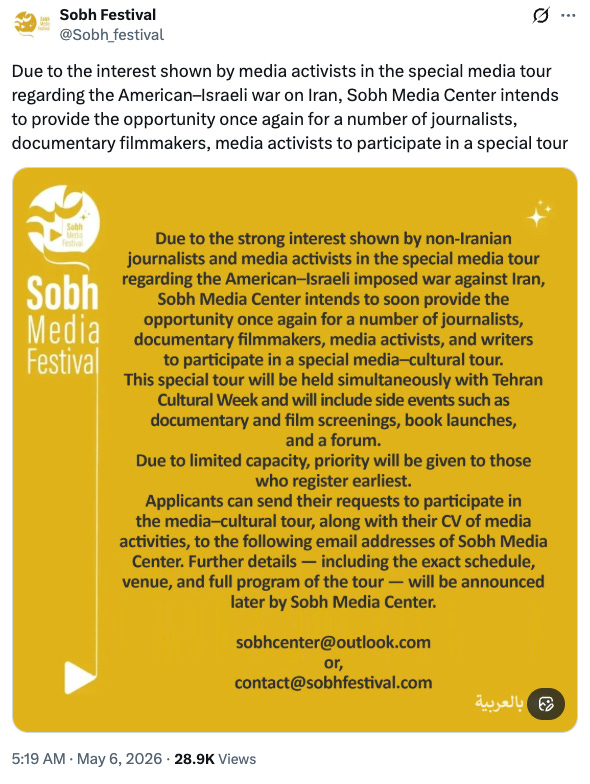
The Sobh Media Festival has already announced the third installment of its tours since the protests and has called for applicants to apply to participate in a “special media tour”.
Case Study: Bushra Shaikh
A primary focus of this campaign has been Bushra Shaikh, a British-Pakistani media activist who gained initial fame in the UK as a contestant on season 17 of the reality TV show The Apprentice. Shaikh participated in both the February and May media tours and played a highly active role in reproducing the government’s narrative.
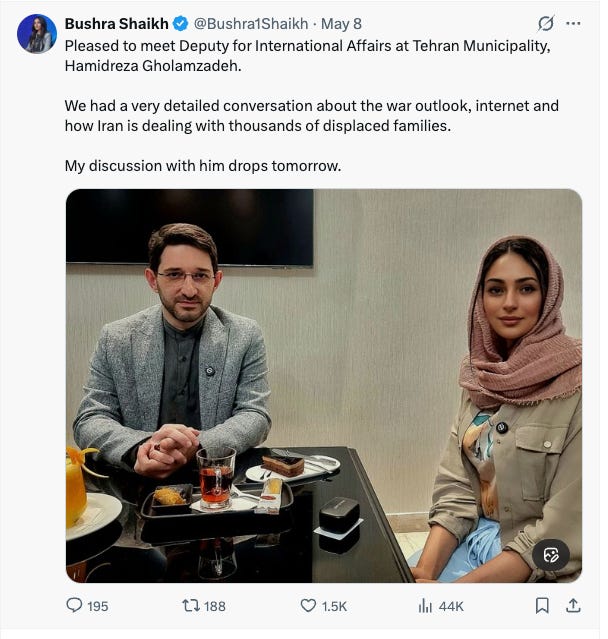
Because of her high-level access, she was allowed to visit highly sensitive military areas, such as the Strait of Hormuz, and conduct off-the-record meetings with senior officials like the Foreign Ministry Spokesperson. Her activity demonstrates how the state utilizes these figures to manipulate Western algorithms.
Algorithmic Success and Social Media Strategy
An analysis of her X (Twitter) account from May 2025 to May 2026 reveals a highly calculated pattern of social media manipulation.
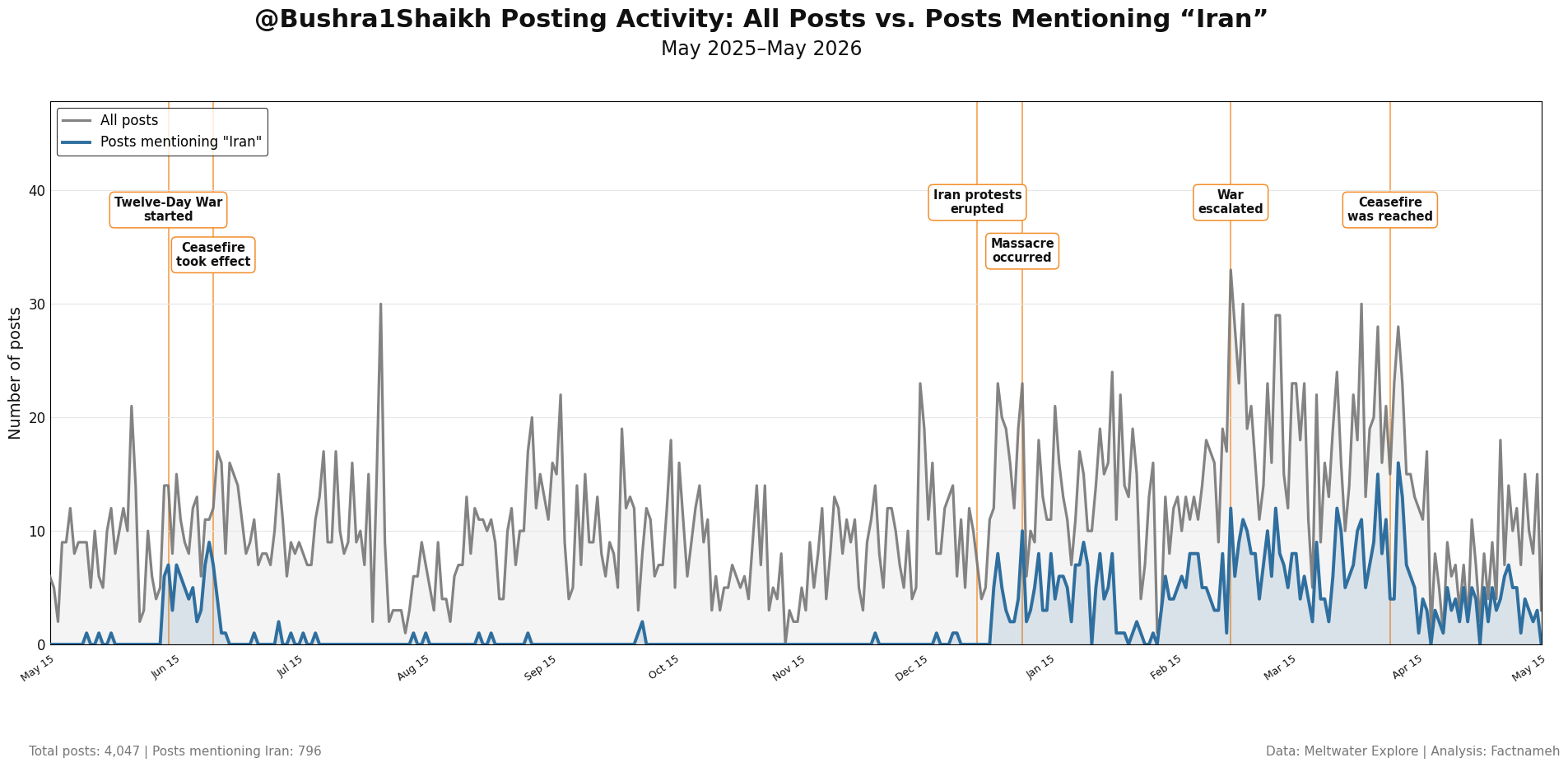
Rather than acting as a traditional journalist providing continuous news coverage, Shaikh’s focus on Iran spiked almost exclusively during critical events, such as the intensification of military conflicts, ceasefires, and nationwide protests. Out of her 4,047 posts during that year, about 20 percent (796 posts) were exclusively about Iran, predominantly published during her state-sponsored media tours.
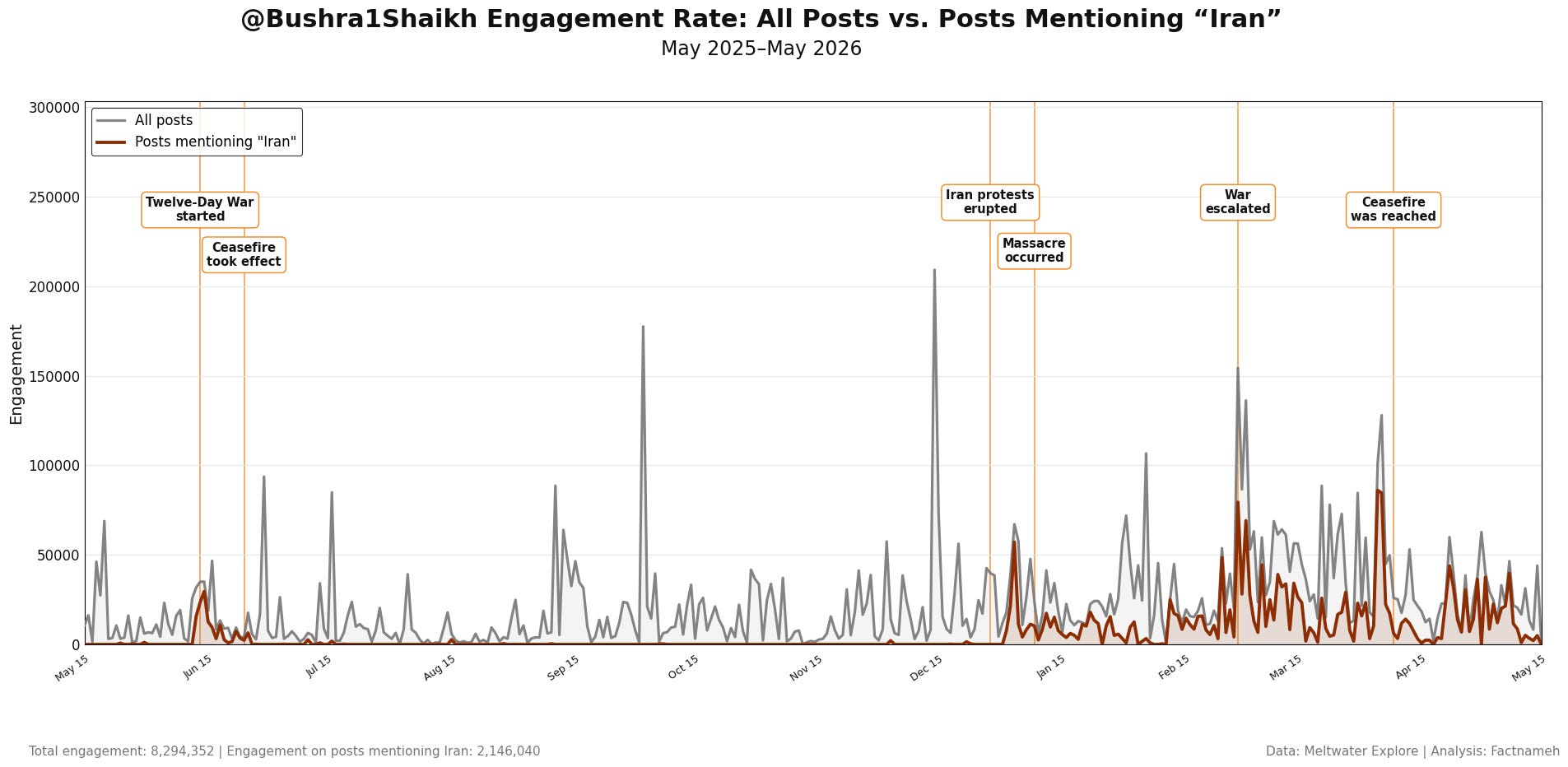
This targeted content resulted in massive algorithmic success. Her Iran-related posts generated disproportionately high engagement, making up more than 2.1 million of her 8.3 million total interactions, roughly 25 percent of her entire page’s engagement for the year. She achieved this by routinely targeting controversial topics and engaging in confrontational discussions that drew attention to her videos. Her online narrative consistently framed Western media and elites as hypocritical and corrupt, while portraying Iran as a rational, restrained country merely defending itself against Western aggression.
Activities and Reporting Inside Iran
During her approximately 20 days on the ground in Iran, Shaikh’s activities strictly adhered to the IRIB World Service’s key propaganda themes, transforming her from an observer into an active participant in state narrative production. To manufacture an image of freedom for Western eyes, she filmed herself walking unveiled through the bazaars of Tabriz and Tajrish.
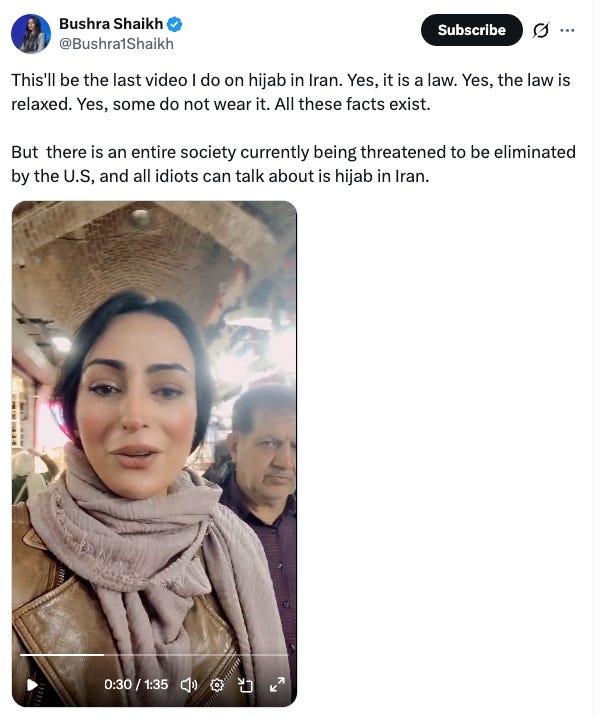
She explicitly framed the compulsory hijab as largely a personal “choice,” mimicking the language of female empowerment while dismissing Western focus on the issue as a distraction from larger threats.
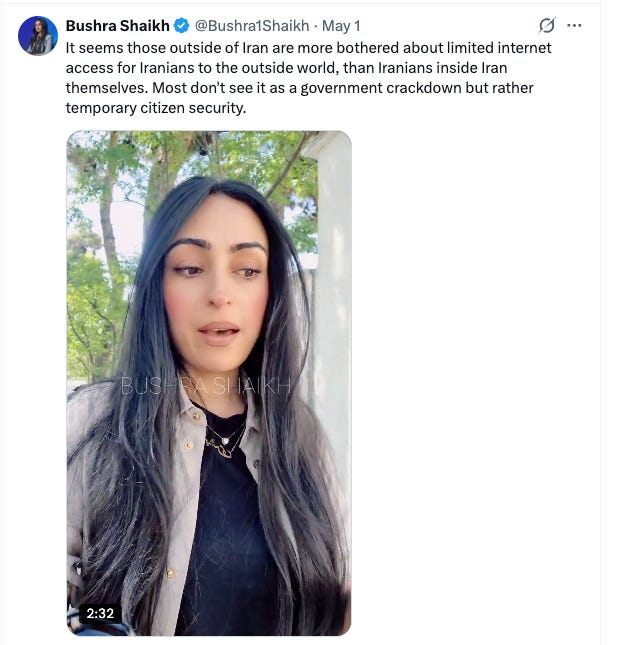
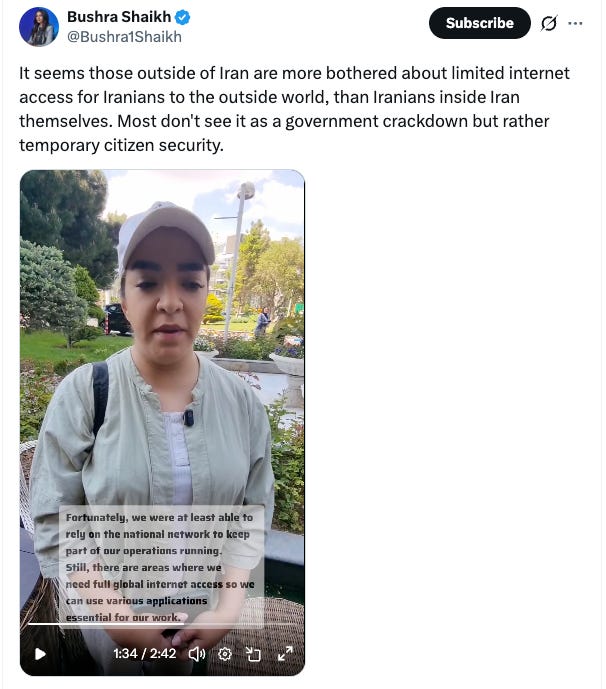
While freely broadcasting these videos, Shaikh was enjoying unfettered internet access during a severe, nationwide digital blackout. Despite official reports detailing the massive economic damage of the shutdown, she defended the state’s actions by claiming that Iranians inside the country viewed the blackout not as government suppression, but as a form of “temporary security”.
Her coverage often included extensive praise for Iran's military capabilities and strategies. Given highly restricted access to the Strait of Hormuz, she abandoned any pretense of objective journalism to praise Iran’s “smart control” over enemy ships, even referring to the waterway as the country’s “nuclear weapon”.
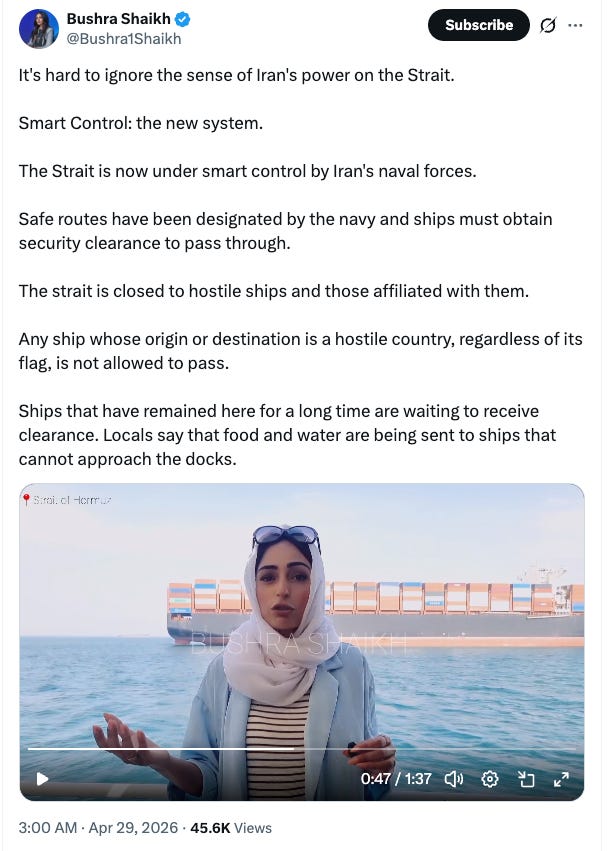
This aligned with her broader efforts to “fact-check” and criticize Western media narratives. She dedicated significant effort to debunking American news networks and politicians, dismissing a Fox News broadcast about internal gridlock as a “ridiculous lie” and attacking Donald Trump as a “crazy liar” by baselessly claiming that reports of Iranian women on death row were actually AI-generated.
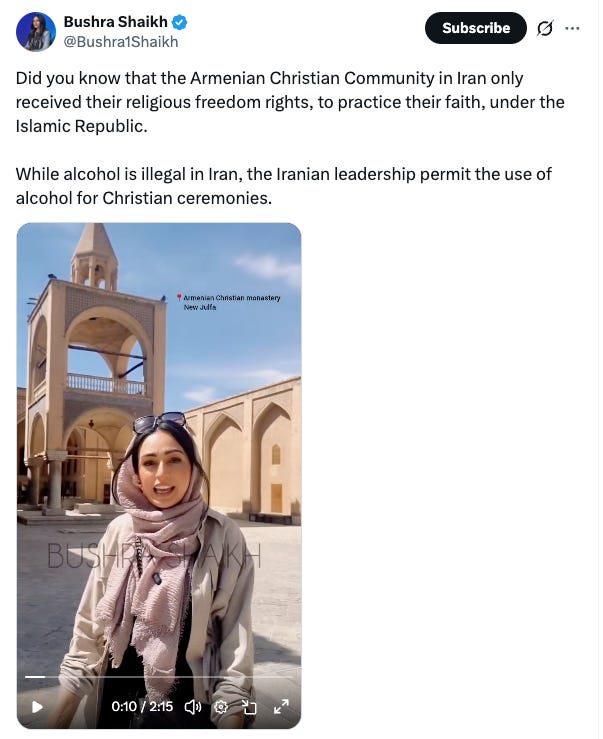
Shaikh also actively distorted the reality of Iran’s domestic situation regarding minorities and protests. She visited an Armenian monastery in Isfahan and published highly misleading reports claiming full religious freedom and parliamentary representation for minorities, conveniently omitting the systemic discrimination and constitutional barriers they face.
Furthermore, she took to the stage at state-sponsored street rallies in Tabriz and Tehran, falsely reporting to her Western audience that the crowds did not want war, directly contradicting the official chants and videos from those very events. Her unprecedented access was further highlighted by off-the-record meetings with senior government officials, including the Foreign Ministry Spokesperson, whom she praised as highly educated and with whom she joked about Western politicians.
The Illusion of an Alternative Narrative
The influencers brought to Iran are not objective observers or traditional journalists; they are active participants in reproducing the state’s dominant narrative. By funnelling resources through the IRIB World Service to co-opt foreign content creators, the Islamic Republic has successfully established a modern, digital influence operation designed to launder its international image.
They rely on the faces of relatable, Western-based influencers to convince global audiences that Iran is free, unified, and powerful, all while ensuring that the authentic voices of the Iranian people remain completely silenced in the dark.