
Manufacturing Blame: Iran's Use of Disinformation Against Afghan Migrants

For many years, Iran has been one of the main places where Afghans fleeing conflict and insecurity have sought safety. But they have long lived in a difficult situation, even though they are essential to the economy, they are persistently vilified. The wave of disinformation and public hostility they faced in the aftermath of the 12-day Iran-Israel war was not a new phenomenon. It was a familiar pattern: when there’s a crisis, people look for someone to blame, and they usually blame the weakest.
This piece is not about the crime rate among Afghanistan-born individuals in Iran. It is about how a media ecosystem manufactures security threats to divert attention, shore up political legitimacy, and incite public outrage when it is needed most. The 12-day war offered such a moment.
A Tense Landscape Long Before the War
Tensions between Iranians and Afghan migrants had already been on the rise well before the conflict. The Taliban’s return to power in 2021 prompted a new wave of migration into Iran, a country already struggling with economic hardship. With inflation surging and job opportunities shrinking, public anxiety quickly morphed into resentment toward outsiders. Some segments of state-linked media and pro-government influencers have periodically weaponized this frustration, reviving old tropes about demographic threats and national security risks. In fact, during the 2022 protest movement, state-linked accounts launched fabricated anti-Afghan hashtags to distract from regime criticism on Persian-language social media. Interestingly, at the beginning, some government-affiliated media, particularly those close to the IRGC, appeared to resist this wave, likely to avoid straining relations with the Taliban. But after the 12-day war, those very outlets quickly pivoted, becoming platforms for publishing security-related accusations targeting Afghan migrants. Soon after, opposition figures and media also fueled anti-Afghan sentiment, spreading claims that Afghan migrants had participated in the crackdown on Iranian street protests, or that the government was bringing in more Afghan migrants on purpose to change the population and help themselves win future elections.
These trends set the stage. When the Iran-Israel war broke out in June 2025, and questions began to mount about the competence of Iran’s security apparatus, authorities returned to a familiar playbook: blaming “foreign infiltrators” and making Afghan migrants the face of that threat.
The Disinformation Campaign After the 12-Day War
After the conflict’s outbreak on June 12, 2025, and continuing well beyond the ceasefire on June 24, reports of arrests and deportations of Afghan nationals in Iran surged. At the same time, Iranian media began amplifying claims—so far without evidence—that Afghan migrants were acting as Israeli spies.
In one widely circulated video from June 16, Iranian media reported that five Afghan nationals were arrested in Lorestan Province with “micro drones.” However, no drones were visible in the footage, and the individuals—actually four men—were seen sitting beside a rural road, with no indication of espionage equipment.

Days later, on June 18, officials claimed that an Afghan university student in Rey was arrested after files related to drone and bomb construction were found on his phone. Naturally, for such a serious accusation, solid evidence should be presented, but so far, that hasn’t happened.
On June 21, a video surfaced showing two allegedly undocumented Afghan men confessing to being Mossad spies. According to state media, they had photographed the headquarters of Iran’s state broadcasting organization (IRIB) and the home of a senior official in Tehran. They supposedly shared the images with a handler in Germany, receiving two thousand dollars in return.
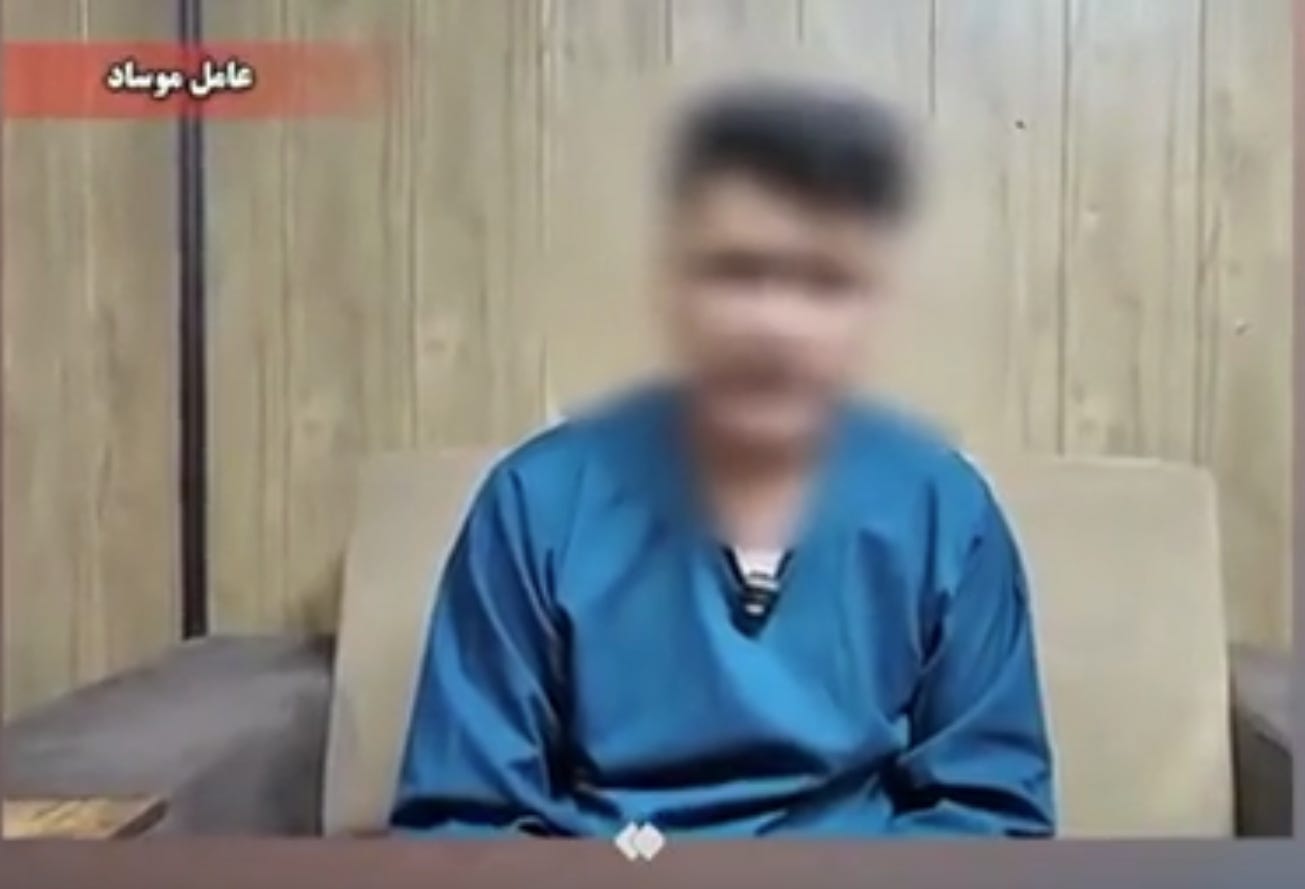
These supposed confessions aired on national TV, but, as with past televised “confessions” in Iran, the circumstances under which they were obtained remain deeply suspect. On social media and in other outlets, responses were pushing back against the accusations made against these two individuals and others like them. Critics pointed out, for example, that there are already hundreds of photos and videos of the IRIB headquarters available online, so why would Mossad need to recruit spies just to photograph a well-known public building? Others noted that the Iranian officials who were assassinated were often targeted in their homes, workplaces, or even while in transit, sometimes even after fleeing an initial attack. This level of precise targeting simply cannot be achieved through basic methods like a photo taken by an undocumented migrant.
Then came another video on June 23: three Afghan men and one Iranian, arrested in Pakdasht, “confessed” to planning to blow up a power station after being paid seven thousand dollars. Again, the only evidence presented was their on-camera statements. It’s also worth noting that Israel didn’t seem focused on minor targets like power stations. Their operations aimed at key military sites, high-profile figures, or major security centers, often using drones, missiles, or targeted killings.

The most disturbing case was reported on July 1, when the IRGC claimed to have thwarted a sabotage operation in the southeastern city of Khash. Five alleged Mossad spies—mostly foreign nationals—were said to be using micro drones to destabilize the country. But human rights group Halvash, which reports on abuses in Baluchistan, told a different story: the operation was actually a raid on a Baluch village, where 12 unarmed women were shot. Two were killed, one lost her unborn child, and several more were injured. The state’s version and the human rights report cannot both be true, and no evidence of drones or espionage was ever released.
Meanwhile, Iranian social media erupted with demands to deport all Afghan migrants. Hashtags like #اخراج_افغانی_مطالبه_ملی (Expel Afghans: A National Demand) and #ابطال_کارت_آمایش_افغانی (Cancel Afghan Residency Cards) began trending. These sentiments spilled into the streets. According to a report by BBC Persian, Afghan migrants described being insulted as “Israeli spies” by ordinary passersby in markets and public spaces.
At least one arrest report, a supposed Mossad spy cell busted in Mashhad, was publicly retracted days later by a provincial security official, who clarified that the 18 Afghan detainees were simply undocumented migrants with no connection to espionage. This correction, of course, received far less media attention than the original claim.
Another viral video claimed that Basij forces had uncovered an underground Mossad base with over 400 illegal Afghans near the IRGC General Staff HQ. The video was aired on Ofogh TV. Later, the video was quietly removed. Afghan media in Iran later identified it as footage from the administrative office of foreign nationals in a Tehran suburb, showing people waiting in line to renew documents, not detainees. The building’s architecture also supports this claim.
All told, even if we take the government’s own numbers at face value, only 16 Afghan nationals were arrested on espionage-related charges out of more than 700 people reportedly detained during the war for alleged collaboration with Israel. With six million Afghans estimated to be living in Iran, both documented and undocumented, that means Afghan nationals accounted for just 2.3 percent of espionage-related arrests. That rate is actually lower than their proportion of the overall population.
Why the Allegations Lack Credibility
The security claims made against Afghan migrants were not just exaggerated; they were structurally implausible.
The first reason is context. Iran’s security agencies were widely criticized for their unpreparedness during the 12-day war. Perhaps in an attempt to regain their reputation, they launched a wave of arrests and televised confessions, including retroactive allegations against prisoners already in custody. Those who were executed after the war for allegedly collaborating with the enemy had all been arrested before the conflict began. Some had even been in prison for years, making it logically impossible for them to have played a role in Israel’s recent operations. Publicizing arrests of supposed foreign collaborators was to create the illusion of competence.
Second, the so-called “evidence” was often riddled with inconsistencies. Looking closely at 11 of the 16 cases involving Afghan migrants accused of spying or drone activity, the details don't add up. Some videos shared online don’t show any real evidence, and in others, the only source is someone confessing under pressure on TV. No clear legal documents or proof have been shared. Many of the suspects appear to have been mistreated. These cases seem to be more about controlling the story and less about actual wrongdoing.
Finally, from a strategic standpoint, the notion that Mossad would rely on vulnerable migrants, people routinely surveilled, racially profiled, and systematically excluded from security-sensitive environments, is far-fetched. Israel’s known intelligence methods in Iran typically involve cyber sabotage, recruited insiders within state institutions, or highly trained dual nationals. While it is not impossible that someone of Afghan origin could be recruited, the idea that Afghan day labourers are key players in Israel’s high-level covert operations defies logic. This is even more implausible given the scale of recent deportations: In 2025, during the months before the war, nearly 348,000 Afghan citizens were forcibly repatriated from Iran, accounting for 58% of the approximately 600,000 who returned during that period. In an environment where Afghan migrants are being systematically targeted and expelled, they are an unlikely choice for clandestine work by any foreign intelligence agency.
The Real-World Impact: Deportation, Violence, Indifference
The disinformation campaign had real and brutal consequences. Since the start of 2025, over 1.76 million Afghans have returned from Iran, many involuntarily, with daily deportations in late July reaching more than triple the early-year average. In the weeks following the war, there was a measurable rise in the number of Afghan migrants being detained and deported. These deportations frequently involve violent treatment, including beatings, harassment, property confiscation, and the destruction of legal documents, with many migrants denied due process. Alarmingly, children constitute approximately 25% of those deported, facing extreme trauma and being sent back to Afghanistan where their lives and basic rights, especially for women and girls, are under immediate threat.
The process itself has grown more violent. Afghan migrants described being beaten by security forces or held in overcrowded detention centers. Humanitarian organizations have flagged an increase in abuses against deportees, including dumping them across the border without documentation, food, or water.
Perhaps most disturbing is the public indifference. Years of propaganda have desensitized the population to the plight of Afghan refugees, who are now casually referred to as “spies,” “invaders,” or “breeding threats” on mainstream platforms.
The Islamic Republic suffered both militarily and reputationally during the 12-day war. In an attempt to regain control of the narrative, it resorted to familiar disinformation tactics, spreading false stories like the supposed downing of Israeli F-35 jets and saturating the media with AI-generated propaganda.
Blaming Afghan migrants seems like another low-cost, high-impact move. With public attitudes toward Afghan migrants already tense and mass deportations underway, the regime found fertile ground for a scapegoating campaign. In times of crisis, the state often resorts to narratives that project strength, even if they come at the expense of lives. Migrants, especially those already marginalized, become easy targets.