
Iran’s Protests: What’s Different This Time?

Since December 28, renewed protests have erupted across dozens of Iranian cities. Initially sparked by economic fury over soaring prices and a collapsing currency, the demonstrations have quickly broadened into a national reckoning. Citizens are voicing outrage against corruption, financial instability, repression, and a political system that is rapidly losing legitimacy in the eyes of its citizens.
Over the past decade, Iran has experienced its fair share of unrest. Since the 2017–2018 protests, the Islamic Republic has repeatedly confronted public dissent. At Factnameh, we have covered these events closely, witnessing both the regime’s violent crackdowns on the streets and its various efforts to manipulate information.
In previous incidents, protesters have often been met with lethal force. During the 2022 Mahsa Amini protests, the conservative death toll exceeded 550, including 68 minors, alongside mass arrests. On the information front, the regime has consistently deployed both state media and social media campaigns to shape narratives, producing parallel or fabricated accounts of events to obscure the reality. This included attempts to misrepresent the deaths of young Iranians who became symbols of the movement. During the 12-day war, pro-government accounts used AI-generated content at an unprecedented scale to push fabricated stories, such as claims of downed Israeli F-35s.
This time, however, feels different. Violence has occurred on the streets (roughly 40 have been killed), and the media spins persist, but the regime’s responses appear disorganized and inconsistent. Consider the controversial attack on a hospital in Ilam, a Kurdish-majority town. Iranian official media claimed that “rioters” had entered and disrupted Imam Khomeini Hospital, allegedly threatening staff, stockpiling weapons, and using grenades. Verified videos, eyewitness accounts, and statements from the Health Ministry tell a different story: families and companions of injured protesters were gathered outside, while security forces escalated tensions by deploying tear gas, breaking doors, beating civilians and medical staff, and forcibly removing wounded patients and bodies. There is no credible evidence supporting claims of an armed occupation or violent protesters inside the hospital.
Minimizing protest size has also been a familiar tactic. Amid widespread reporting on the large protests in Abdanan (Ilam province) on January 6, 2026, Fars News Agency claimed only 2,000 demonstrators were present. Multiple videos and images from various streets contradicted this figure. Our analysis of a widely shared 45-second video from Valiasr Street, using crowd flow and static crowd capacity methods, showed that the 2,000 figure would be surpassed within minutes, with thousands visible in a single scene. Footage from other streets suggests total participation may have exceeded 20,000.
We also observed coordinated online propaganda. Some Arab influencers posted videos from calm Tehran streets, speaking to their audiences about stability before praising the Islamic Republic. Examining their activity, language, and repetition of narratives aligned with official positions makes it clear that these individuals exhibit an ideological leaning toward the regime. Evidence suggests they participated in a coordinated effort to project a false sense of calm during the protests for their audiences.

Uncertainty and Inconsistency
Yet, during the first ten days, state media and officials largely remained quiet. Unlike past protests, when narratives were aggressively pushed, there seems to be no coherent information strategy. The judiciary and police commander have been among the few vocal figures, threatening “rioters” with extreme punishments and calling for “swift trials with deterrent sentences,” even taking to X to promise “no mercy.”
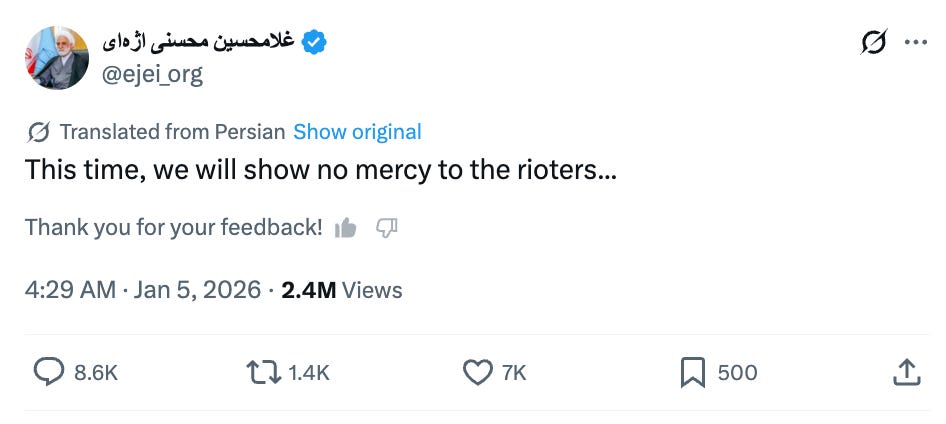
Meanwhile, President Massoud Pezeshkian has not only not used threatening rhetoric against the protesters but has openly remarked that the ruling elites have lost public trust.
The regime’s uncertainty is evident. Unlike previous protests, at least until Jan 8th there appears to be no coordinated plan to suppress demonstrations, either physically or through information control in the level practiced in the past. One factor may be warnings from President Trump that Iran would “pay hell” if it killed its citizens. This threat, combined with recent U.S. military action, seems to have restrained the regime’s use of force, at least for now.
That may soon change. As crowds swell, particularly following Crown Prince Reza Pahlavi’s call to action, the government has shut down the country’s internet. This is the third such shutdown in the past decade, the first of which in 2019 coincided with severe bloodshed and mass arrests.
***
Iran’s current protests reflect both continuity and change. Violence, information manipulation, and repression remain tools of the state, but the regime’s confusion, hesitancy, and lack of a coherent strategy are striking. As the protests continue to grow, the coming days may reveal whether the regime can regain control or whether this moment marks a new phase of public defiance in Iran.